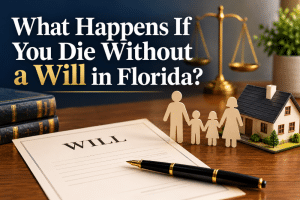
 Most people assume they have time to create a will, but here’s a sobering reality: only 46% of U.S. adults have one. So what happens if you die without a will in Florida? The state steps in and makes all the decisions for you through intestate succession laws. Dying without a will in Florida means losing control over who inherits your assets and who raises your minor children. Florida intestate law follows a strict hierarchy that may not line up with your personal wishes. Probate without a will in Florida often takes longer and costs more. It can create family conflict that could have been avoided. In this piece, I’ll walk you through what happens if you die without a will in Florida and who inherits under intestate succession. Creating even a basic will can protect your family from legal complications.
Understanding What Happens If You Die Without a Will in Florida
When death occurs without a valid will, Florida Statutes Chapter 732 activates. Your family receives no input on asset distribution. The court applies a predetermined formula that governs every intestate estate in the state.
The State Makes Decisions for You
Florida’s intestate succession laws function as a default will the legislature wrote on your behalf. So your estate passes through probate with a judge distributing assets according to statutory requirements rather than your personal instructions. Your surviving relatives cannot negotiate alternative arrangements, even if everyone agrees a different distribution would work better.
The system ignores circumstances that might have mattered to you. A child with special needs who requires additional financial support gets the same share as other children. A spouse who built the family business alongside you receives no recognition for that contribution. Relationships outside legal definitions receive nothing under intestate law. This includes stepchildren you raised or close friends you called family.
Florida’s Intestate Succession Order Explained
The distribution follows a rigid hierarchy under Florida Statutes Sections 732.102 and 732.103. The surviving spouse inherits first, though the amount depends on whether descendants exist and whose children they are. If no spouse survives, descendants inherit the entire estate.
Without descendants, your parents receive equal shares. The surviving parent takes everything if only one remains. If no parents survive, siblings and their descendants inherit. The statute then splits the estate between paternal and maternal relatives, starting with grandparents and moving to their descendants. If one side of the family has no survivors, the other side receives the entire estate.
When Your Estate Goes to the State
Escheat occurs only when no eligible heirs exist within the degrees of kinship Florida recognizes. Under Florida Statute Section 732.107, the state sells the property and deposits proceeds into the State School Fund. This outcome remains rare because the law’s design reaches distant relatives.
Property doesn’t become state property right away. Legitimate heirs have 10 years from the date proceeds reach the Chief Financial Officer to reopen the estate administration and claim their inheritance. After that window closes, the state’s rights become absolute.
Who Inherits Under Probate Without a Will in Florida
Florida intestate law under Section 732.102 determines inheritance based on your family structure at death. The distribution follows specific rules that depend on relationships, not personal wishes.
Spouse Inheritance Rules
Your surviving spouse’s share hinges on whether you have descendants and whose children they are. Your spouse inherits everything if you had no descendants at all. The same applies if all your descendants are also descendants of your surviving spouse and your spouse has no other descendants—your spouse receives the entire estate.
The calculation changes with blended families. Your spouse receives only one-half of your intestate estate if you had children from a previous relationship or if your surviving spouse has descendants who are not your descendants. Your descendants inherit the other half. This split protects children from prior relationships who might otherwise receive nothing.
Children and Descendants Distribution
Your children inherit everything in equal shares without a surviving spouse. Florida distributes assets per stirpes, meaning descendants inherit by family line. Those grandchildren step into their parent’s position and receive that share if your child predeceased you but left children of their own.
Parents and Siblings as Heirs
Your parents inherit equally if you leave no spouse or descendants, or the surviving parent receives everything. Siblings inherit next with no living parents. That sibling’s descendants take their parent’s share if a sibling predeceased you.
Extended Family and Distant Relatives
The statute extends to grandparents, then aunts and uncles and their descendants. Florida splits the estate between paternal and maternal sides equally. The other side receives the full estate if one side has no survivors.
Special Rules for Adopted and Biological Children
Adopted children inherit the same as biological children under Florida Statute 732.108. Adoption legally severs ties with biological parents, except when a spouse adopts a natural parent’s child. The adopted child maintains rights to both the natural parent and the adoptive parent in that scenario.
Stepchildren and Foster Children Cannot Inherit
Stepchildren have no inheritance rights under Florida intestate succession unless legally adopted. Foster children receive nothing as well. Even decades of family relationship creates no legal claim to your estate without formal adoption.
The Hidden Costs of Dying Without a Will in Florida
Financial and administrative burdens multiply at the time probate without a will in Florida begins. Asset distribution rules aside, intestate succession triggers practical costs most families never anticipate.
Longer Probate Timeline
Intestate estates often take longer to resolve because the court must determine and locate all heirs. Formal probate administration runs 6 to 9 months under standard circumstances. The process can take longer without a will and may involve more court oversight. The court must appoint a personal representative and determine heirs based on state law. This adds time and complexity to the process, especially if family members disagree.
Higher Legal and Court Fees
Florida probate costs between 3% and 7% of the gross estate value. Court filing fees run around USD 235 to USD 402 in 2026. Attorney fees follow Florida Statute 733.6171 and start at USD 1,500 for estates up to USD 40,000. They scale to 3% of value for estates between USD 100,000 and USD 1 million.
Guardianship Issues for Minor Children
The Florida court will hold a hearing to determine who should receive custody if no guardian is named and both parents pass away. The process may be delayed. Family members could end up in conflict over who should raise your children. Worse, the court could appoint someone you would never have chosen. Court-supervised property guardianship becomes required once a minor’s inheritance exceeds USD 15,000.
Public Records and Privacy Loss
Probate is a public process where your estate’s details become part of the public record. Probate records in Florida are public records under the Sunshine Law. Anyone can access your information—friends, relatives, nosy neighbors, former spouses and thieves. This lack of privacy can lead to unsolicited advertising and identity theft.
Taking Control: Estate Planning Solutions
An estate plan puts you back in control once you understand what happens if you die without a will in Florida.
Why a Simple Will Changes Everything
A will directs asset distribution according to your wishes rather than Florida intestate law. You select beneficiaries, name a personal representative you trust, and nominate guardians for minor children. The court cannot appoint a guardian without your clear nomination, and contested guardianship proceedings get pricey. A will guides the court and names the person you want to handle your estate.
How Living Trusts Avoid Probate
A revocable living trust transfers asset ownership during your lifetime and avoids probate entirely. Your successor trustee distributes assets directly to beneficiaries, typically within weeks rather than months or years. Statutory attorney fees alone can reach USD 15,000 for a USD 500,000 estate. A living trust avoids those costs entirely.
Trust funding remains critical. You must retitle assets in the trust’s name. An unfunded trust provides no probate protection. A pour-over will transfers any remaining assets into the trust.
Working With a Florida Estate Planning Attorney
A Florida estate planning attorney will give you documents that comply with state law and work together. Florida typically charges between USD 1,500 and USD 3,500 for trust preparation, including the trust document, pour-over will, power of attorney, and healthcare directive.
Florida makes every decision about your estate, your children, and your legacy if you die without a will. You can prevent this outcome with simple estate planning. A simple will gives you control over asset distribution and guardianship choices. A living trust can bypass probate entirely. Consult a Florida estate planning attorney now that you understand the potential risks. Leaving everything to chance and state law is worse than having even a simple plan.
FAQs
Q1. Who receives property when someone dies without a will in Florida? When there’s no will, Florida’s intestate succession laws determine who inherits. If you’re survived by a spouse and no children, your spouse receives everything. With children involved, the distribution depends on whether they’re from the current marriage or previous relationships. If there’s no spouse, children inherit equally. Without immediate family, the estate passes to parents, then siblings, and eventually extended family members following a specific legal hierarchy.
Q2. How long does probate take in Florida when there’s no will? Probate without a will in Florida typically takes longer than with one—often 6 to 9 months or more under standard circumstances. The extended timeline occurs because the court must identify and locate all legal heirs, appoint a personal representative, and provide additional oversight. The process becomes even longer if family members disagree about the estate distribution or guardianship arrangements.
Q3. What happens to bank accounts after death without a will in Florida? Bank accounts without designated beneficiaries become part of your probate estate when you die without a will. These accounts are distributed according to Florida’s intestate succession laws rather than your personal wishes. The funds go through the probate process, which means they’re subject to court supervision, legal fees, and the state’s predetermined distribution formula based on your surviving relatives.
Q4. Can stepchildren inherit if there’s no will in Florida? No, stepchildren have no inheritance rights under Florida’s intestate succession laws unless they were legally adopted. Even if you raised stepchildren for decades and considered them family, they receive nothing from your estate without formal adoption or being named in a will. The same applies to foster children—family relationships alone don’t create legal inheritance rights.
Q5. What are the costs of probate without a will in Florida? Probate without a will typically costs between 3% and 7% of the gross estate value. Court filing fees range from approximately $235 to $402, while attorney fees start at $1,500 for smaller estates and scale up to 3% for estates between $100,000 and $1 million. For a $500,000 estate, statutory attorney fees alone can reach $15,000, not including additional costs from extended timelines and court supervision.
We Help Clients Secure Their Legacy and Protect Their Assets With Trust & Estate Planning Legal Services
We understand the importance of protecting your legacy and providing for your loved ones. Our experienced team of estate planning attorneys is dedicated to helping you navigate the complexities of trusts and estate planning, ensuring your wishes are honored and your assets are protected.
> Learn More
Contact Us (954-466-7451) for a Consultation!
—
 About ARK Legal Group
 About ARK Legal Group
We are your trusted legal partners for life’s most important moments…
- Real Estate Law – Guiding you through property transactions and disputes
- Personal Injury Law – Advocating for your rights after an accident
- Trusts & Estate Planning – Securing your legacy and protecting your assets
- Probate Law – Assisting with the complexities of estate administration
With a commitment to personalized service and a track record of success, we’re here to provide expert legal counsel tailored to your unique needs. Let us help you navigate the legal landscape with confidence and peace of mind.
> Learn More